Shikaku Puzzle: Play Plotsprout Free Online


Planting your garden…
What is a Shikaku puzzle?
A shikaku puzzle is a grid of cells where a few cells carry numbers. Your job is to cut the whole grid into rectangles so that each rectangle contains exactly one number and covers exactly that many cells. Squares count as rectangles, nothing overlaps and no cell is left over. The word shikaku is Japanese for square, literally “four corners”.
Plotsprout is our own take on the shikaku game, set in a sunny allotment garden. Every number is a seed stake, every rectangle you draw becomes a fenced bed, and a correct bed sprouts its crop. Tuck the snail comments on good beds and slips. It runs in your browser on a phone or a desktop, and every board has exactly one solution, so a shikaku puzzle here never needs a guess.
How do you play Shikaku in Plotsprout?
Here is Level 3, a small 5×5 board, in four real screenshots from the game.
-
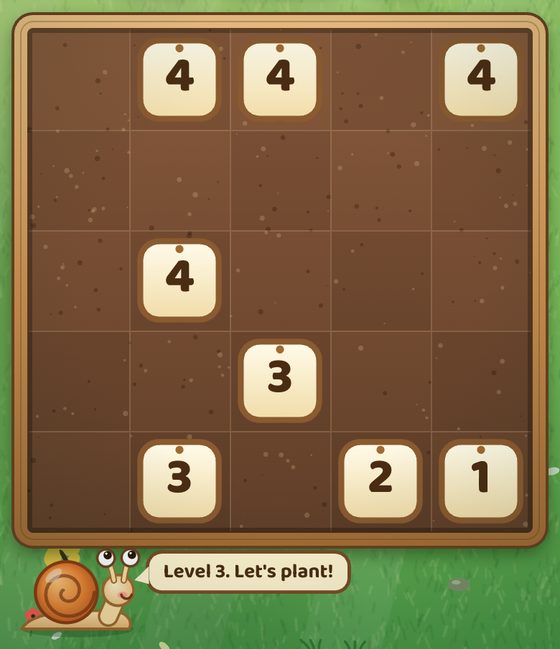
1 Read the stakes. The eight numbers add up to 25, the number of cells. The two 4s side by side in the top row can never share a bed, so a fence runs between them. -
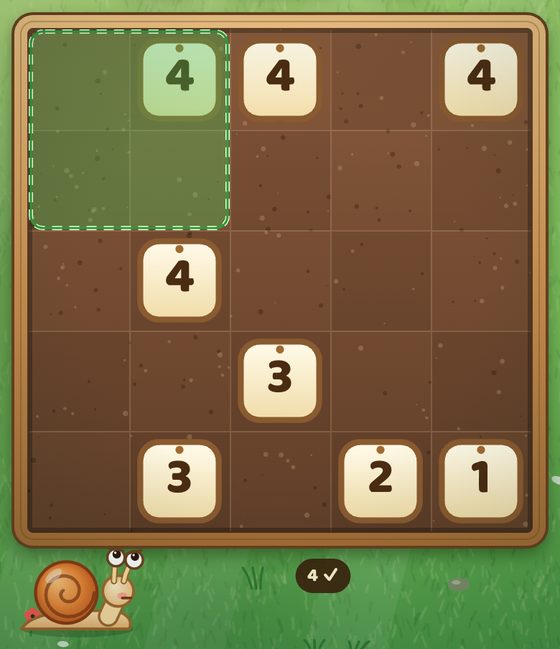
2 Drag from one corner of a bed to the opposite corner, or tap the first cell and then the last. The preview turns green when the shape holds one stake and the right number of cells. -
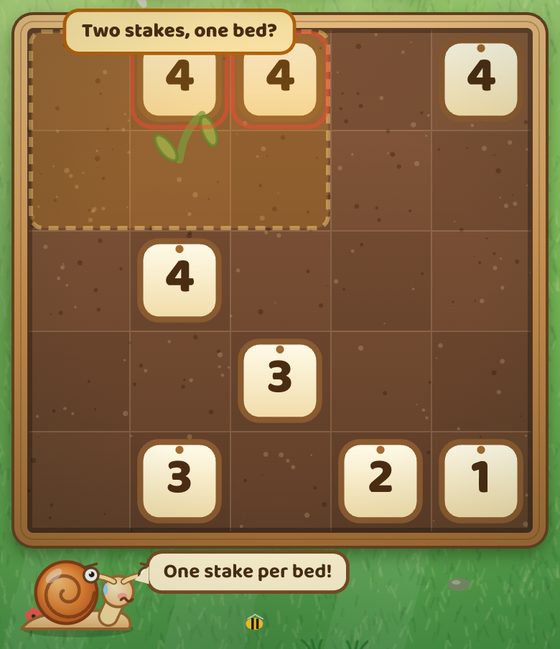
3 A wrong shape turns amber and Tuck says why, here two stakes in one bed. There is no pop-up. Wrong tries count as slips toward the tidy star. -
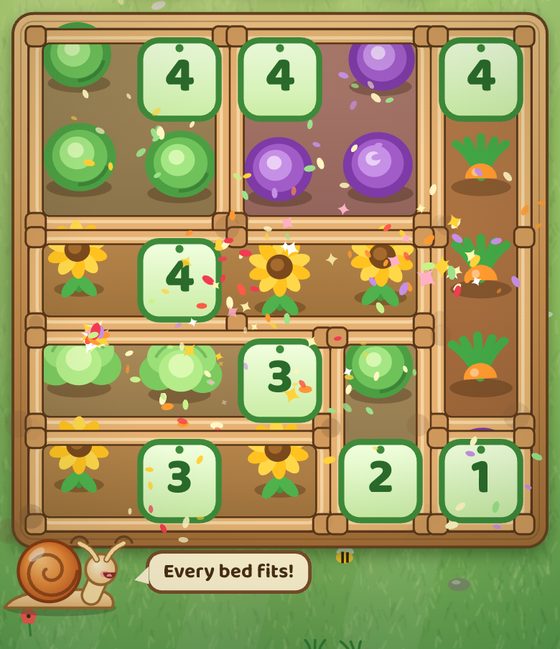
4 The finished garden: eight beds, 25 cells, no soil left bare. Tap a bed to pull it up, undo as often as you like, and tap during the bloom to skip to your time and stars.
Three tools sit under every shikaku puzzle board. Undo has no limit, Clear empties the board, and Hint highlights a bed you can place next or points at one that is wrong. A hint costs the tidy star. The timer starts when you first touch the board.


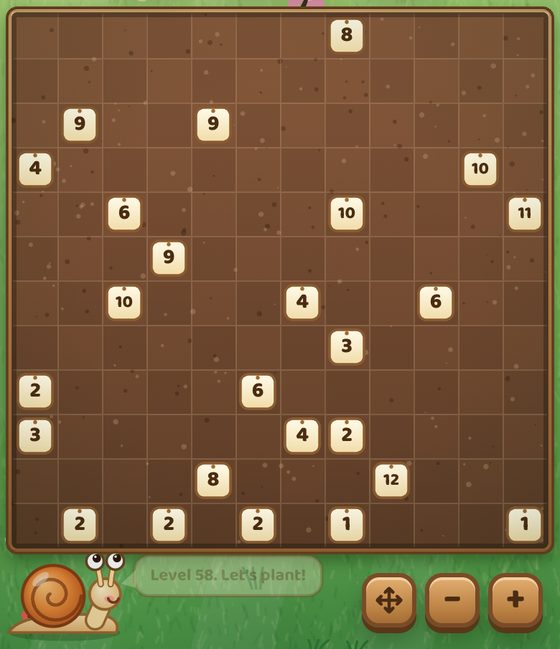
An 11×11 campaign board, 14 beds down and 12 to go. Later boards are the same shikaku puzzle rules on a bigger plot.
How do you solve a shikaku puzzle?
Techniques for any shikaku puzzle, from first steps to the look-ahead moves that bigger boards ask for.
- Beginner
-
Plant the 1s and the straight strips. A 1 is a single cell. A prime such as 2, 3, 5 or 7 has no other factor pair, so it can only be a 1×n strip.
Fence between neighbours. Two numbers in touching cells can never share a bed, so the border between them is certain.
Count the shapes. List every factor pair of a number, 12 gives 1×12, 2×6 and 3×4 plus their turns, then cross off shapes that leave the board or swallow a second number.
- Intermediate
-
Start with corner clues. A big number in a corner has fewer places to stand than one in the middle, because the edge of the board removes many shapes.
Place forced rectangles. When a number has exactly one legal rectangle left, place it. That shrinks the board and often creates the next forced bed.
Ask who can reach a cell. Pick an empty cell and list the numbers that can still cover it. If only one can, that bed must include the cell.
- Advanced
-
Look-ahead elimination. Assume one option for a number and follow it. If it seals off a pocket of cells that no remaining number can fill, that option is out.
Budget the area. The numbers add up to the cell count. If a region of empty cells is walled off, the stakes that fit inside must add up to exactly its size.
Trust the single answer. If two options both survive every check, one of them fails further away. Most boards from Medium upward need at least one look-ahead step.
What is the daily shikaku puzzle in Plotsprout?
Every day brings four new boards, one per size, and everyone gets the same four. A new day starts at midnight US Eastern, and Day 1 was November 27, 2026.
Easy 6×6
The warm-up. Mostly forced beds with a little reasoning.
Medium 9×9
Every board needs look-ahead somewhere.
Hard 12×12
Zoom turns on, and about half the beds need deeper thought.
Master 15×15
The biggest plot, with the longest chains of deduction.
Finish any daily size and your streak grows by one. Your best time for each size is saved on your device, and Share copies a short result with your time and sunflowers, without spoilers. Looking for a daily shikaku puzzle you can finish on a coffee break? Start with Easy and move up.
How many shikaku puzzle levels are there?
The campaign has 60 levels that grow from 5×5 to 12×12. Levels 1 to 5 are teaching boards that can be finished with forced beds alone. From around level 11 a few beds need look-ahead, and the last stretch leans on it.
Each level gives up to three sunflowers: one for finishing, one for a tidy garden (at most two slips and no hints) and one for beating the par time on the result card. Progress and stars are saved in your browser.
- 5×51–7
- 6×68–14
- 7×715–22
- 8×823–30
- 9×931–38
- 10×1039–46
- 11×1147–53
- 12×1254–60
How do big shikaku puzzle boards work on a phone?
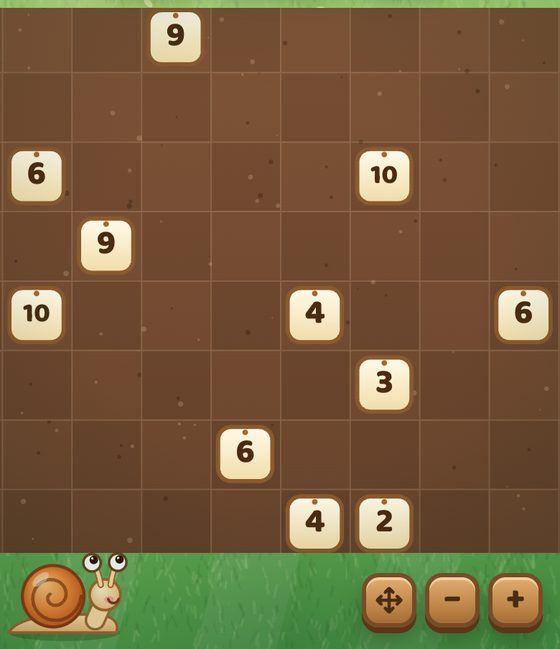
Boards of 12×12 and up, which means Hard, Master and levels 54 to 60, first appear whole so you can see the full garden. Then you zoom to place beds precisely. Pinch with two fingers, use the mouse wheel, or press the + and − buttons or keys. A pan button lets you drag the board around while zoomed.
Smaller boards stay at one fixed size, because their cells are already easy to hit.
Can I replay past daily shikaku puzzles?
Yes. The Past days button opens from Day 2 onward. Pick any earlier day and any of the four sizes and play it again. Replays never touch your streak, so you can catch up on a missed day or revisit a favourite without risk.
Planted today’s garden? Find more daily puzzles on Play Mossy, including sun-and-moon quilts and number terraces.
Shikaku puzzle questions
What is the best way to start a shikaku puzzle?
Plant every 1, then fence between numbers that touch, because they can never share a bed. After that, handle primes (2, 3, 5, 7), which can only be straight strips, and the big numbers in corners, which have the fewest legal shapes.
Is Plotsprout free, and do I need an account?
It is free, runs in your browser and needs no download and no sign-up. Your progress, stars, streak and best times are saved on the device you play on.
Can I play shikaku on my phone?
Yes. Drag from one corner of a bed to the opposite corner, or tap the first cell and then the last. Boards of 12×12 and larger can be pinched to zoom. A mouse works the same way on desktop.
Does every shikaku puzzle have exactly one solution?
Yes. Every campaign level and every daily board is checked by a solver to have exactly one answer, so you can always reason your way to the end without guessing.
Do squares count as rectangles in shikaku?
Yes. A square is a rectangle with equal sides, so a 4 can be a 2×2 bed as well as a 1×4 or 4×1 strip.
What happens if I draw a wrong rectangle?
The preview turns amber and Tuck the snail tells you why, for example that the bed holds two stakes or the wrong number of cells. Nothing is lost, but each wrong try counts as a slip toward the tidy star. Undo has no limit.
How many shikaku puzzles can I play?
There are 60 campaign levels from 5×5 to 12×12, plus four new daily boards every day in Easy 6×6, Medium 9×9, Hard 12×12 and Master 15×15. Every earlier day can be replayed from the Past days button.
How does the timer and star scoring work?
A timer starts when you first touch the board. Each campaign level gives up to three sunflowers: one for finishing, one for a tidy garden with at most two slips and no hints, and one for beating the par time shown on the result card.
How is the daily shikaku different from the campaign?
The daily is the same set of four boards for everyone and changes at midnight US Eastern. It feeds your streak and a saved best time for each size. The campaign is a fixed ladder of levels you can play in order at your own pace.
Will I lose my streak if I replay an old day?
No. Replays from Past days never touch your streak. Only finishing a current daily board adds to it. Because progress lives in your browser, clearing site data for this page also clears it.
Finished today's garden? More calm puzzle games on Play Mossy.
Comments
No comments yet. What is your fastest Easy time, or which technique saved your Hard board?